References (15)
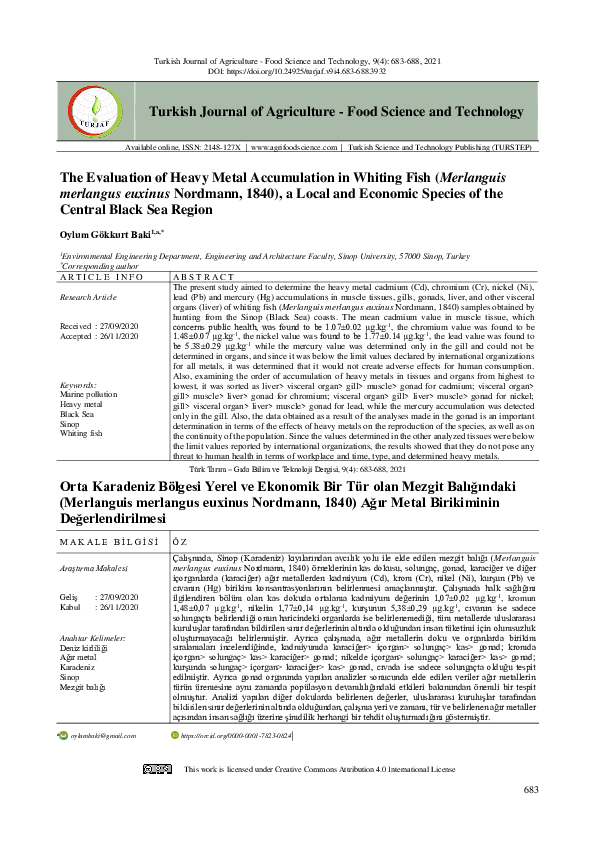
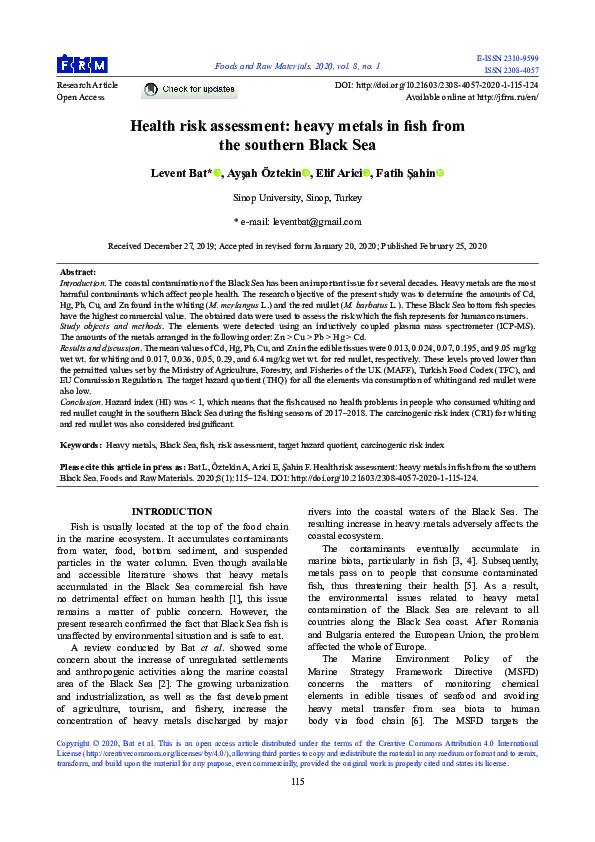
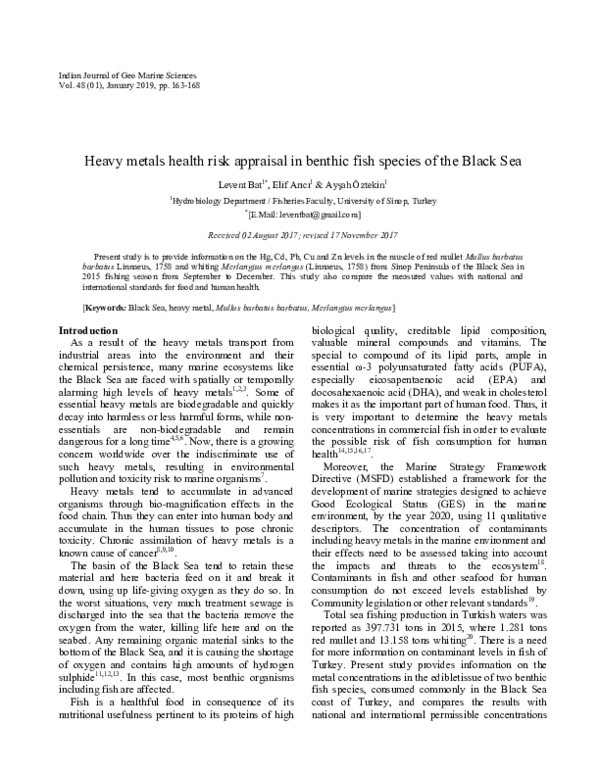
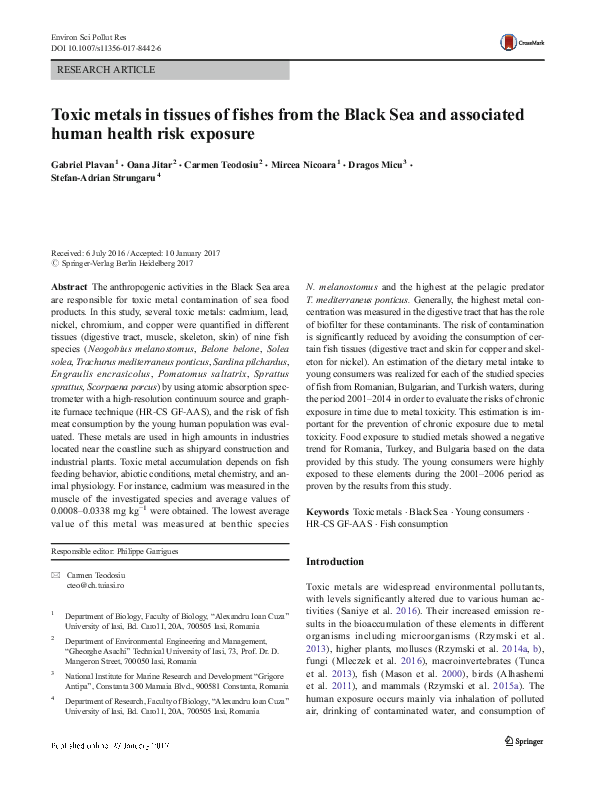
Baltas, H., Sirin, M., Dalgic, G., Bayrak, E. Y., & Akdeniz, A. (2017). Assessment of Metal Concentrations (Cu, Zn, and Pb) in Seawater, Sediment and Biota Samples in the Coastal Area of Eastern Black Sea, Turkey. Marine Pollution Bulletin, 122(1-2), 475-482. https://doi.org/10.1016/j.marpolbul.2017.06.059Bat, L., Gökkurt, O., Sezgin, M., Üstün, F., & Sahin, F. (2009). Evaluation of the Black Sea Land Based Sources of Pollution the Coastal Region of Turkey, The Open Marine Biology Journal, 3, 112-124. https://doi.org/10.2174/1874450800903010112Bat, L., Sezgin, M., Gökkurt-Baki, O., & Sahin, F. (2013a). Determination of heavy metals in some commercial fish from the Black 1 Sea coast of Turkey. Walailak J Sci & Tech 2013; Agricultural Technology and Biological Sciences, 10(6), 581-589.Bat, L., Şahin, F., Sezgin, M., Üstün, F., Gökkurt-Baki, O., & Öztekin, H. C. (2013b). Heavy metals in edible tissues of the brown shrimp Crangon crangon (Linnaeus, 1758) from the Southern Black Sea (Turkey), J. Black Sea/Mediterranean Environment, 19(1), 70-81.Bryan, G. W. (1976). Some aspects of heavy metal tolerance in aquatic organisms. In In A. P. M. Lockwood (Ed.), Effects of Pollutants on Aquatic Organisms (pp. 7-34). Cambridge University Press.Cevik, U., Damla, N., Kobya, A. I., Bulut, V. N., Duran, C., Dalgic, G., & Bozaci, R. (2008). Assessment of Metal Element Concentrations in Mussel (M. galloprovincialis) in Eastern Black Sea, Turkey. Journal of Hazardous Materials, 160(2-3), 396-401. https://doi.org/10.1016/j.jhazmat.2008.03.010Eremeev, V. N., Ivanov, L. M., Jr Kirwan, A. D., & Margolina, T. M. (1995). Analysis of Caesium in the black sea by regularization methods. Mar. Pollut. Bull., 30, 460-2. https://doi.org/10.1016/0025-326X(94)00207-P FAO. (2010). Statistics Division Food Security Statistics, Food Consumption. [Online] Available: http://www.fao.org FAO/WHO. (2004). Food and Agriculture Organization/World Health Organization. Summary and Conclusions of the Sixty-first Meeting of the Joint FAO/WHO Expert Committee on Food Additives (JECFA). [Online] Available: www.fao.org/3/a-at878e.pdfGedik, K., & Ozturk, R. C. (2019). Health Risk Perspectives of Metal (loid) Exposure via Consumption of Striped Venus Clam (Chamelea gallina Linnaeus, 1758). Human and Ecological Risk Assessment, 25(5), 1176-1188. https://doi.org/10.1080/10807039.2018.1460802Gomoiu, M. T. (1992). Marine Eutrophication Syndrom in the Northwestern part of the Black Sea. In R. A. Vollenweider, R. Marchetti & R. Vicviani (Eds.), Marine Coastal Eutrophication (pp. 683-692). Elsevier, Amsterdam. https://doi.org/10.1016/B978-0-444-89990-3.50059-6Google Maps. (2021). [Online] Available: https://www.google.com.tr/maps/dir/Türkiye Gökkurt-Baki, O. (2011). Coastal Management in Sinop Province. Ondokuz Mayıs University, Graduate School of Natural and Applied Sciences, Doctoral dissertation. pp. 287.Gökkurt-Baki, O. (2021). The Evaluation of Heavy Metal Accumulation in Whiting Fish (Merlangius merlangus euxinus Nordmann, 1840), a Local and Economic Species of the Central Black Sea Region. Turkish Journal of Agriculture -Food Science and Technology, 9(4), 683-688. https://doi.org/10.24925/turjaf.v9i4.683-688.3932Mee, L. D. (1992). The Black Sea in Crisis: a Need for Concerted International Action. Ambio, 21, 278-86.Mutlu, T. (2021). Heavy Metal Concentrations in the Edible Tissues of Some Commercial Fishes Caught along the Eastern Black Sea coast of Turkey and the Healthrisk assessment. Spectroscopy Letters, 54(6), 437-445. https://doi.org/10.1080/00387010.2021.1939386Phillips, D. J. H., & Rainbow, P. S. (1994). Biomonitoring of Trace Aquatic Contaminants. Environmental Management Series, Chapman and Hall. pp. 371. https://doi.org/10.1007/978-94-010-9129-9Turkish Environment Foundation. (2003). Turkish Environment Foundation Publication. Turkey's environmental problems (in Turkish). pp. 472.